February 13, 2026
By Adam Messer
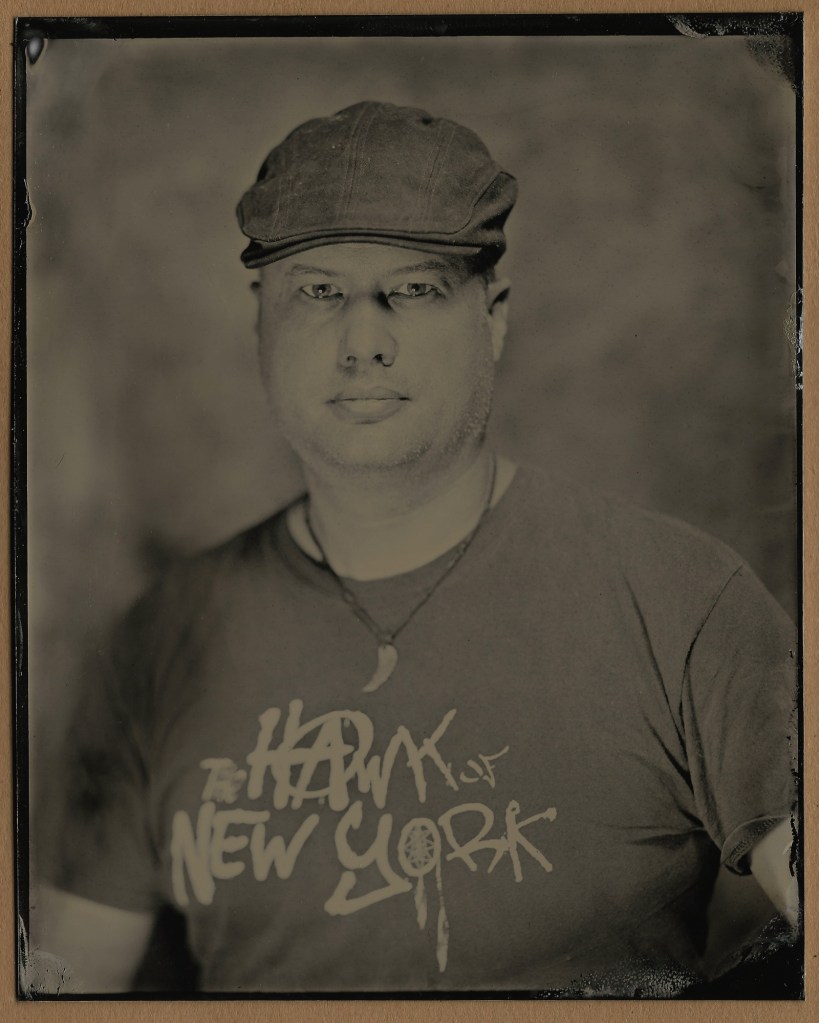
Randyl Bishop is an artist, writer, and publisher who dreamt of creating comic books and turned that dream into reality.
Please introduce yourself.
Hi, I’m Randyl Bishop. I am a retired US Army Officer with two (and a half) degrees in art and one in business. I created a publishing imprint I call Timebound Entertainment. I have come to grips with the fact that I may be more businessman and leader than artist, but I won’t let go of any of those three things because they have come to define who I am ever since I started selling art commercially twelve or so years ago. So, I invite you to read my answers with this in mind.
What genres do you create art and why?
I tend to do things that are either really silly or really horrifying, with a dash of adventure and action.
What is your earliest memory of reading?
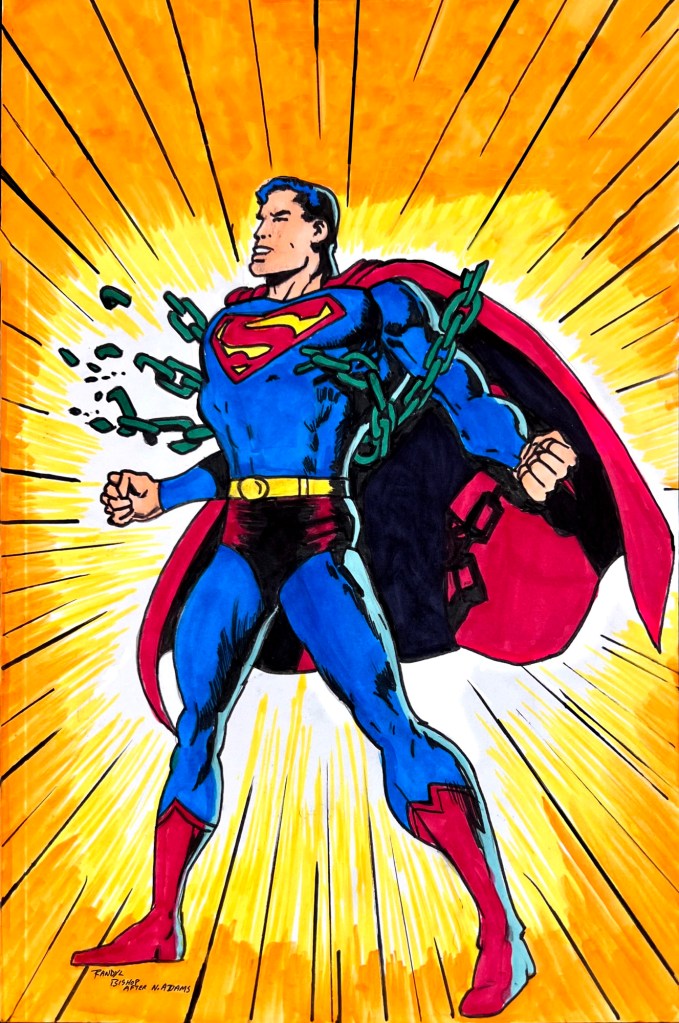
I remember very clearly sitting in my hometown’s library reading in the kid’s room lots of times. I remember the room smell, what the step stools used to reach higher shelves looked like, everything. My aunt was the librarian for something like thirty years and she would watch me (and my brother) sometimes. There were books on Universal Monsters where I was introduced to The Creature from the Black Lagoon and Frankenstein (and more), “Which Way?” books, and a single trade hardback of early Wonder Woman. I remember reading near this poster of Superman that said “Knowledge is real Power” which was a part of a 1980s literacy campaign. I loved that poster so much that I recreated it with paint markers on masonite and hung it in my son’s room.
When did you know you wanted to create art? How did it happen?
I just knew that if I did everything exactly the way my parents and teachers wanted, I would never be free or happy or even get it right. So I didn’t. I just sort of leaned into the opposite, embracing the fact that no matter what we as human beings do, it’s always going to be an experiment, so why not have fun with it? I didn’t really understand that I was making art, I just thought I was acting naturally. I remember in Kindergarten making Superman, Batman, and Dracula out of the construction paper pieces that was left over from some boring exercise.. something really lame like “cut out the shape”. My mother saved some of them, and that was the earliest I can remember of being encouraged at such a young age. Later, in first grade I was caught doodling impossible animals and monsters during class and the teacher, flabbergasted, asked me if I wanted to draw those on the board for all to see. I said “Would I?!” in delight. My reply caught her completely off guard and she ended up letting me decorate an entire bulletin board the length of her classroom. It was years later that I realized she was just trying to embarrass me into conformity. I didn’t pick up on it at all. I’m a little slow that way. Lol I’ll spare you the rest of my elementary school art career, but those drawings got such an unexpected positive response from the class I ended up decorating the front of the classroom later with approved clip art the teacher had picked out (a graduate and a hula(!) dancer). She let the class vote on which ones I would copy and make larger by hand.
What’s one of your favorite scenes in one of your works?
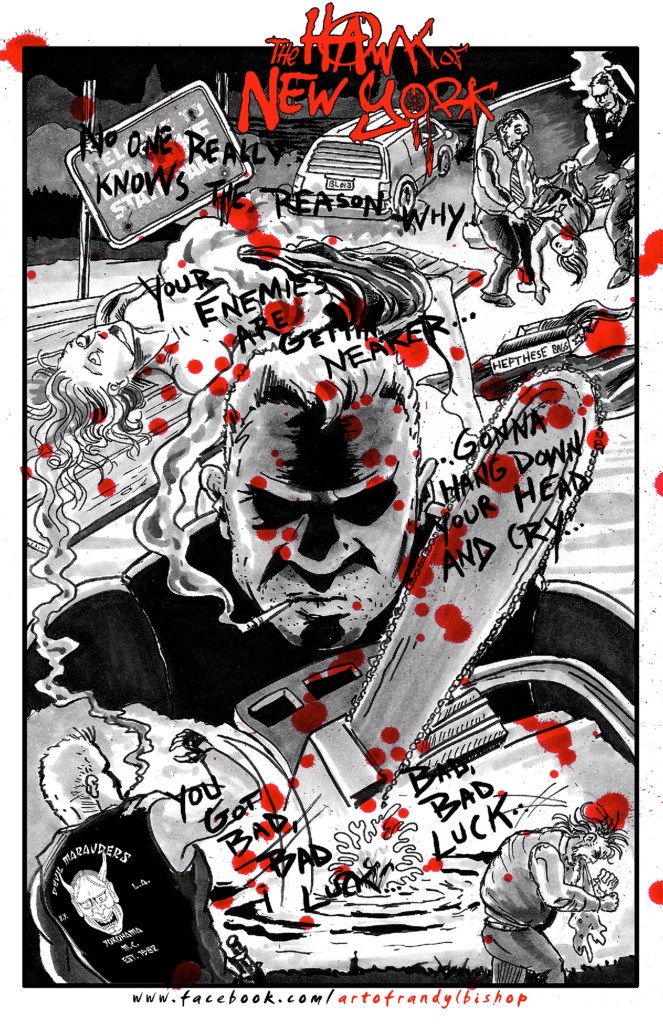
I am really proud of how the montage scene came out in the first issue of The Hawk of New York that really shows who Bill Thrall is. He later becomes the number one bad guy Eric (the title hero) has to deal with and I think it’s a fitting introduction. The lighting on that page was in the school of the late great Tim Sale, who I had the pleasure of interacting with a handful of times.
What makes a good character? A bad one?
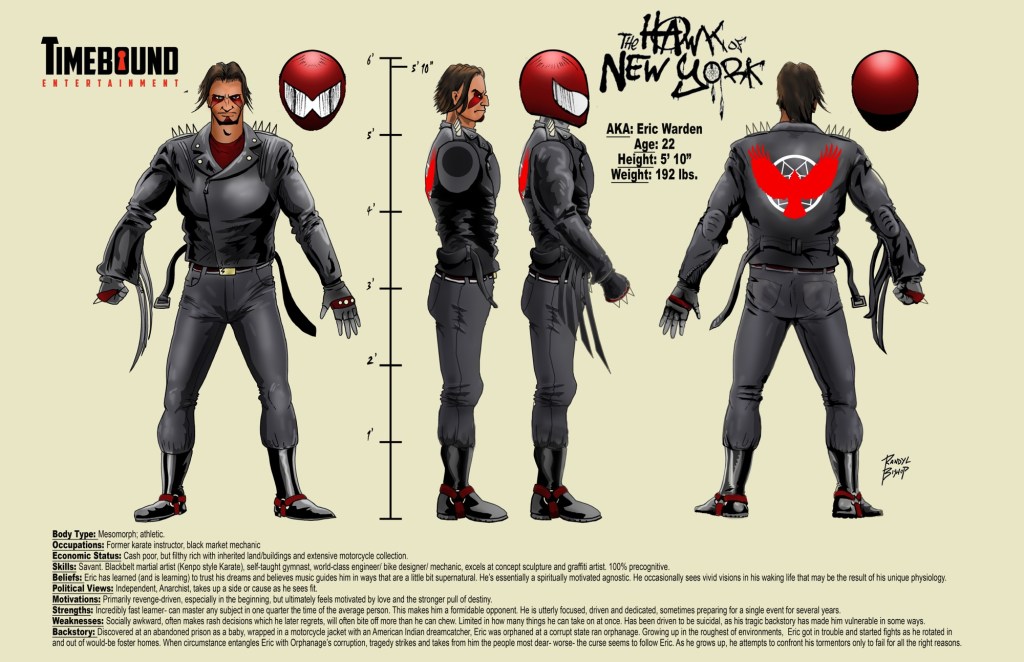
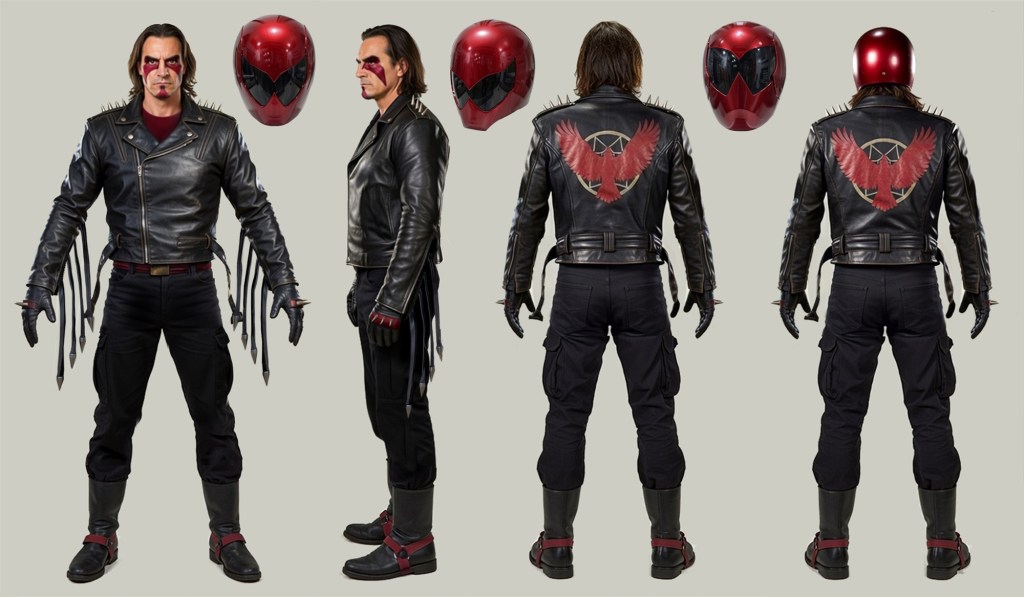
I think characters are good when they are relatable. They also have to have real integrity while at the same time some semblance of a developmental arc. They are bad when they do not have these qualities or when the “arc” is really just a real-world business decision that has nothing to do with the established story. Or when the characters are just obvious avatars for the author, or worse, some activist or political cause supported by the producers. The people that do that usually don’t appreciate or understand the medium very well, or if they do, just don’t care that they are screwing the audience. For example, while my character Eric (The Hawk of New York) Warden has some of the same traits I have, he’s by no means anywhere close to being autobiographical. He’s instead like someone we’ve all kind of come in contact with but could never really get to know- and I think good characters have that ethereal- just out of reach quality that can be a window into a world we may never have direct access to but are fascinated with all the same. Eric will do and say things I would never do or say but I can certainly let the broader story express my opinion if I want—just not at the expense of Eric’s (or other character’s) integrity, which can often be a pain to work around when writing, but readers generally appreciate the trouble I think. This is the kind of work an amateur or a bad actor just won’t be able to complete.
What moves the story for you?
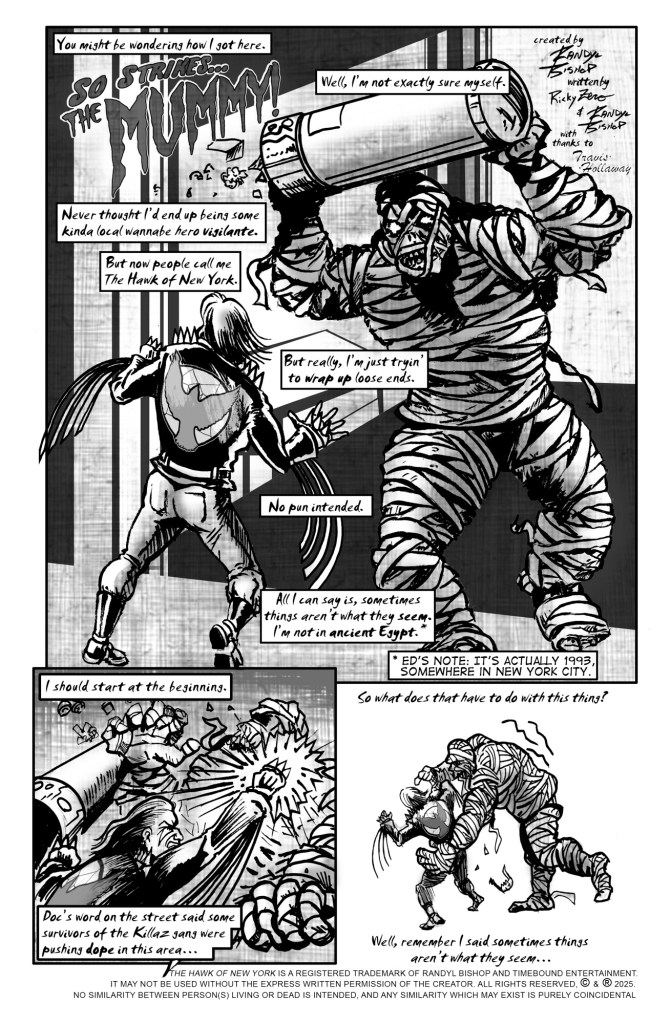
Well, I’m not sure how to answer it other than to say it’s moved by whatever I get an inkling to illustrate, and the desire to figure out how to get there. That’s probably not a very writerly thing to say, but it’s the truth. I kind of subscribe to the old DC Comics 1970s Superman comic book cover art approach. Those old guys would come up with a ridiculous cover (“Jimmy Olsen menaces Metropolis!” “Man of Steel or Man on Jelly?” “Why is Lois marrying Lex Luthor’s robot butler?” etc.) and then only after that art is complete do they figure out the actual story that breaks it down and explains why Jimmy Olsen becomes a giant turtle. I recently wanted an excuse to have my character The Hawk of New York fight an Egyptian mummy, so I drew it, then called my friend Ricky Zero to write a story. He ended up talking me out of doing a worse story and the short story that appears in the latest CSRA Anthology is the result.
What is your favorite book and why?
Lately, it’s been the Holy Bible. I know that’s probably not a very cool thing to say, or maybe a “look at me, I’m suuuch a better person that you” thing but I don’t mean it that way. The Bible has so much value on so many different levels that it’s still pretty much unmatched by any other book. I think the famous celebrity professor Dr. Jordan Peterson is fond of pointing out that it’s not actually a book, but a library of books, and I think he’s right. This is sort of a cheat code way of regarding a book I find fascinating, because we can certainly apply that logic to some other enduring stories (like Superman, for instance). The design of the book- what documents were included and why- are particularly fascinating in light of all the recent discoveries in Egypt with evidence suggesting the use of high technology for very interesting reasons by very ancient peoples who were thought to be nowhere near that level of advancement. These discoveries are actively rewriting the history we were taught as children and the implications are staggering to our modern society. Yet all of this “new” stuff was at least alluded to in the Bible if not outright described in detail. It’s amazing how small excerpts from it can carry such a giant impact on our lives whether Christianity is something you subscribe to or not. There’s no denying its positive impact on humanity. Also, I love Tolkien’s The Lord of the Rings for obvious reasons. lol
What do you want to say to your audience?
I love you guys. I feel like I’m often not able to be the entertainer you guys truly deserve, in terms of volume or quality, yet for some reason, you stick around to see what I’m going to do next, support me in unexpected ways and it’s pressure I should probably cater to more often. What I’m trying to say here is thank you. I’m trying to pull off something that’s very difficult for someone like me to do, and most of you have picked up on that. For that I am really grateful and hope I don’t let you down. I probably will. Lol. But I don’t feel great about that, just so you know.
What advice do you have for new artists?
The best advice I ever got probably has to be “The process is more important than the product.” That is truer today than ever, with AI promising an instant gratification of that creative urge when, in days prior, you really had to earn that payoff. It’s a real temptation to ditch process in favor of quick return, which is the antithesis of art I think and more akin to business. “Form follows function” or similarly “Fat over lean” are some other nuggets of wisdom that won’t ever change. A building contractor I hired one time casually just said “always build from the top down when you can.” And it’s brilliantly the same idea.
Do you have anything else you would like to add?
Well, further on the subject of AI, I certainly do. It’s been a dark cloud that has increased in size and darkness in the past four years that we in the creative industry have been oppressed by. I personally know more than one person who lost their income due to layoffs caused directly from AI. It’s like this, but it doesn’t have to be. I’ve started experimenting with it privately, without committing to public or commercial use until the ethics of using it become a bit more straightforward. It honestly reminds me of the early days of digital photography in the 1990s and how upsetting that was for the chemical photographers, many of whom quit in disgust from the move to digital. (I personally know two that never returned to anything creative after quitting.) I am not ready to quit, but it’s certainly negatively impacted my studio workflow and sales. Culture is completely different now than it was when I started telling my The Hawk of New York story. Out of this era, I’ve come to regard all of AI as just another stupid Photoshop filter. As in Photoshop, in order for the filter to be effectively used and not hokey-looking, it has to be integrated fully into process, and reviewed and edited into a meaningful design. That means there are still plenty of jobs for creatives if we remain optimistic and open to adjusting our entire workflows. The change will be too great for many, but it won’t break us if we don’t let it.
Website:
 Action Pulp!
Leave a comment